IEM upgrade cable
Chorrang!
Cables, measured.
Purity Series is an upgrade cable built by electronics engineers. Every claim on this page has a number next to it, and every number has a method next to that.
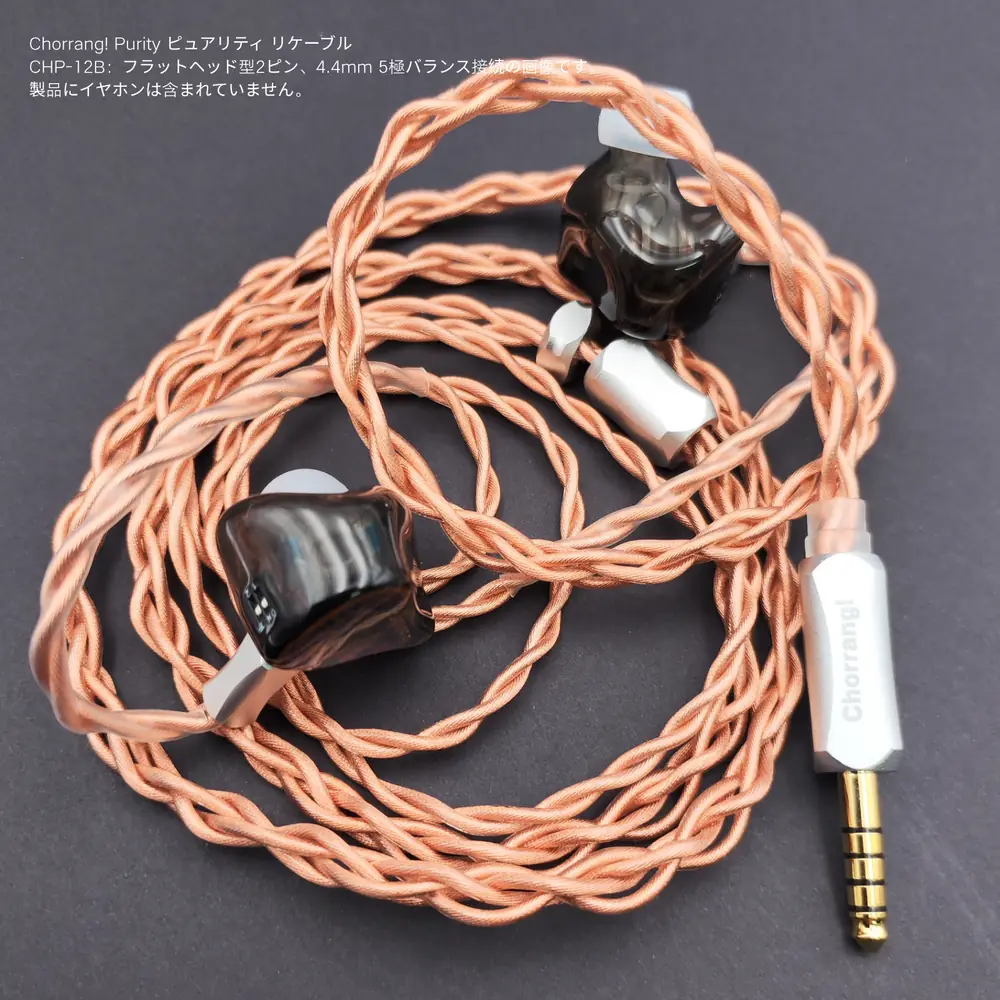
The brand
“Chorrang!” is an onomatopoeia. It is the sound an electric guitar makes when a power chord is struck hard — loud, dense, an impact you notice before you can name it. We picked a noise rather than a word, because this brand starts from listening rather than from a story about ourselves.
The people behind it work at Gateway Electronics Limited, a company that builds high-reliability information-technology products. Ours is an electronics-engineering culture: schematics, test rigs, yield, and a habit of not shipping what we cannot measure. None of that stops us from being people who like music and like sitting down to listen to it.
Looking at what gets sold as audio gear raised a plain question: can we build the thing that we and other people who care would actually want to buy? So we wrote down a floor for ourselves first. Our products will not be described in the language of audio mysticism. They will carry electro-acoustic figures that someone else could repeat. They will be priced by what it costs to build them properly. Once those three points were on paper, the distance between them and the rest of the shelf was obvious — and that distance became the brand.
Purity Series
Purity is our first product line, and it is one cable: an upgrade cable (a re-cable) for in-ear monitors. Before drawing anything, we surveyed and compared what is actually sold in this category — which figures are published, which are asserted without evidence, and which never appear at all.
Purity is the electronics-engineering answer to that survey. Its job is deliberately narrow: to add as little as possible between your earphones and their own sound. A cable cannot improve a driver. What it can do is fail to add resistance, fail to add sample-to-sample variance, and fail to add noise — so that the frequency response and the noise floor your earphones were designed around are the ones you actually get.
That is the whole claim. Everything under this heading is the evidence for it.
Conductor
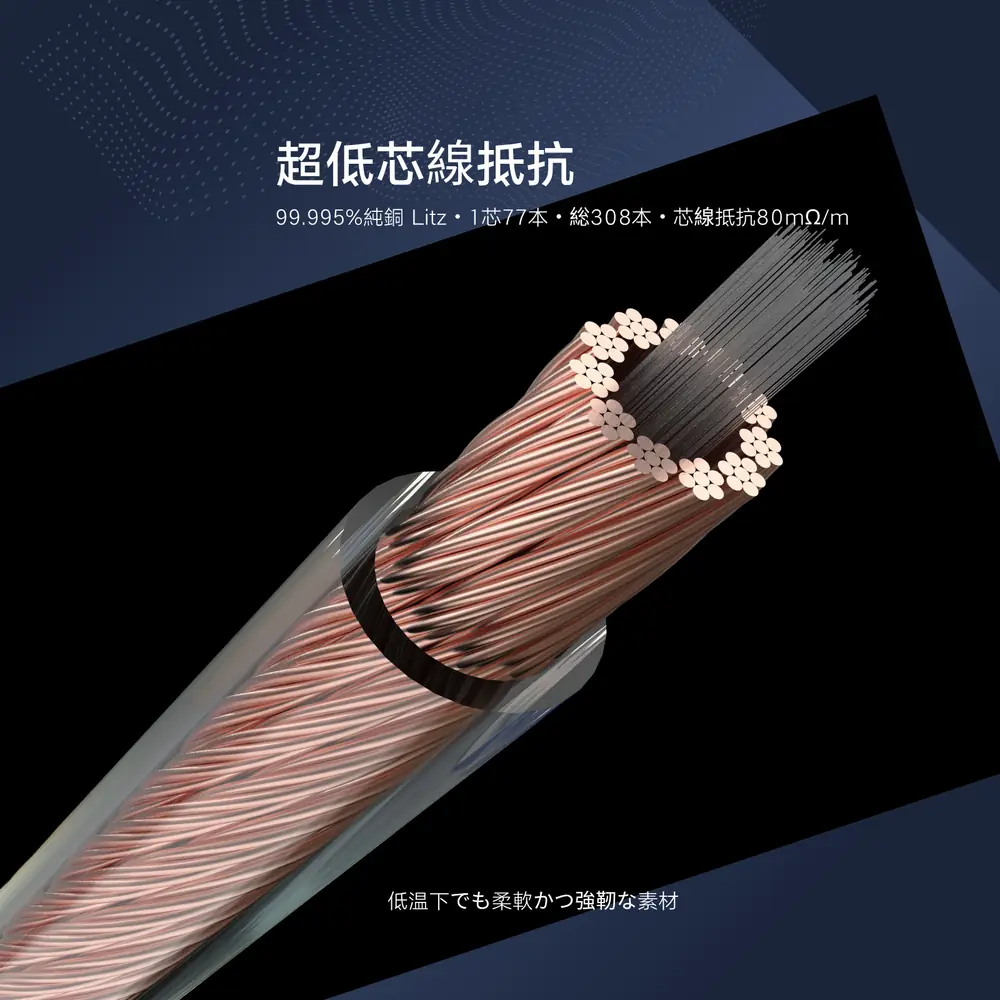
The conductor is multi-strand pure-copper Litz: fine insulated strands, laid up into cores, one core per signal path.
Fine strands are a mechanical decision, not an acoustic one. Through the audio band the skin depth in copper is far larger than any strand in this cable, so strand diameter does not reshape the sound; it decides how the cable behaves in the hand — flexibility, resistance to kinking, and how the jacket behaves in the cold. Stiffness at low temperature is a real failure mode in this category, and it is one we designed against.
At the ends, the contacts are gold-plated. Gold is there because contact resistance has to stay stable over many plug and unplug cycles, not because of any claimed sound signature.
- Copper purity
- 99.995%
- Strands per core
- 77per core
- Strands total
- 308strands
- Core resistance
- 80mΩ/m
Specification
The table under this heading is the specification we hold ourselves to. Two notes on how to read it.
The resistance figure is stated per core. A four-core cable carries four separate signal paths, and a single “cable resistance” number on a four-core cable is ambiguous unless it says which path it means.
Second, where a figure is a design specification rather than a measurement of a finished cable, the table says so. A number we have not yet measured on the production build is labelled as pending, not presented as measured.
| Series | Purity Series |
|---|---|
| Model codes | CHP-12A to CHP-12J |
| Conductor | 99.995% pure copper (Litz) |
| Stranding | φ0.06 mm × 77 strands per core × 4 cores (308 strands total) |
| Length | 1.2 m |
| Core resistance | 80 mΩ/m per core |
| Contacts | gold-plated contacts, 2 µm |
| Basis | Specification value from the conductor build (φ0.06 mm × 77 strands per core), quoted per core. Finished-cable measurement on the production build is pending and will replace this line when done. |
| Measurement method | Finished cables will be measured four-terminal (Kelvin), converted to 20 °C, including connectors, averaged over samples. |
| In the package | Cable, Hook-and-loop strap, CPE bag |
Jacket stays flexible and tough at low temperature.
Earphones shown for illustration; they are not included.
Connectors
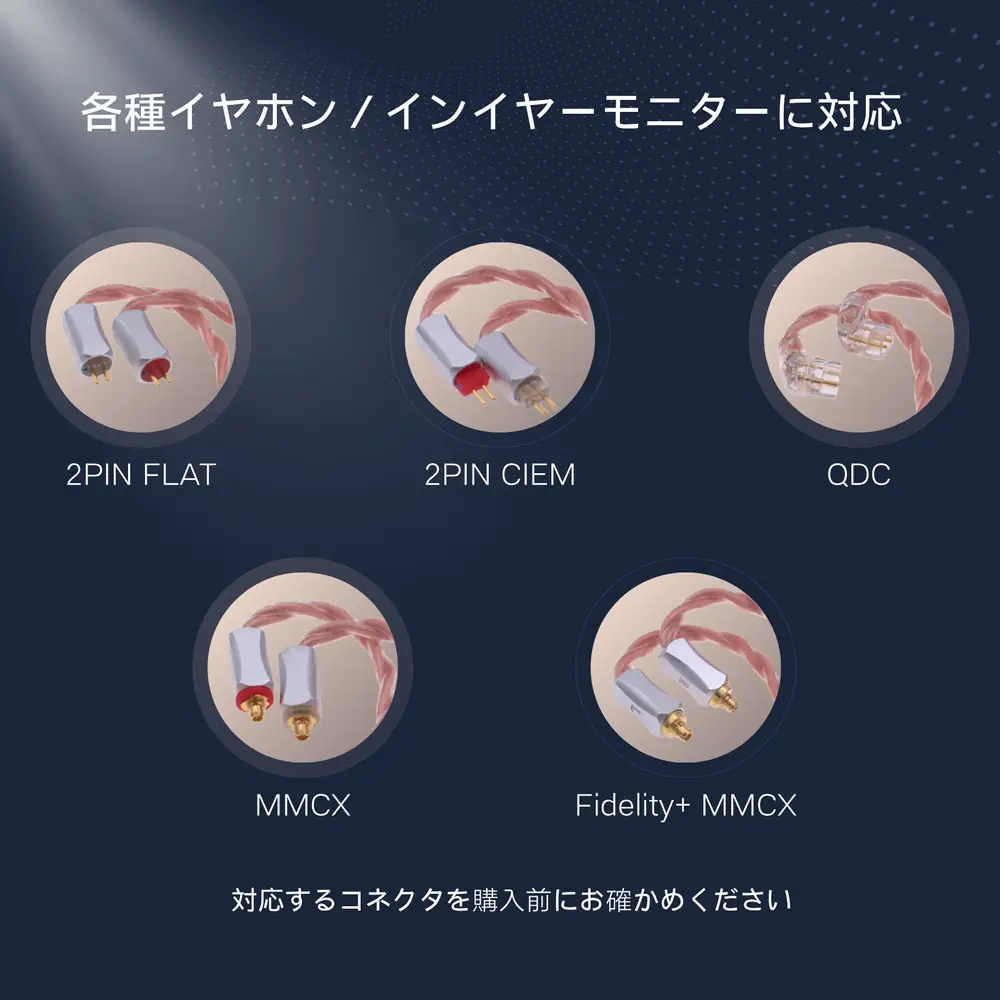
Every order code below pairs one connector system on your earphones with one plug on your source. Check the shape on your own earphones before ordering — the difference between a flat and a recessed two-pin, and between MMCX and Fidelity+ MMCX, is not visible once the cable is fitted, and a connector that does not match is the most common way this purchase goes wrong.
Fit matters after purchase as well as before it. A connector seated with a little play is a resistance that varies with movement, and it will dominate every other figure on this page. If you are unsure which system your earphones use, send us a photo of the socket and we will tell you.
Every order code below is 1.2 m. Check the connector shape on your earphones before buying.
| SKU / Model | Earphone side | Source side |
|---|---|---|
| ACHP-12A | 2-pin 0.78 mm flat | 3.5 mm single-ended (3-pole) |
| BCHP-12B | 2-pin 0.78 mm flat | 4.4 mm balanced (5-pole) |
| CCHP-12C | 2-pin 0.78 mm recessed (CIEM) | 3.5 mm single-ended (3-pole) |
| DCHP-12D | 2-pin 0.78 mm recessed (CIEM) | 4.4 mm balanced (5-pole) |
| ECHP-12E | MMCX | 3.5 mm single-ended (3-pole) |
| FCHP-12F | MMCX | 4.4 mm balanced (5-pole) |
| GCHP-12G | Fidelity+ MMCX | 3.5 mm single-ended (3-pole) |
| HCHP-12H | Fidelity+ MMCX | 4.4 mm balanced (5-pole) |
| ICHP-12I | QDC | 3.5 mm single-ended (3-pole) |
| JCHP-12J | QDC | 4.4 mm balanced (5-pole) |
Measurements
We publish two things in full: how a cable is measured, and what a cable can actually change. Both are on separate pages, because neither belongs in a sales paragraph.
The testing page states the instrument, the method, the conditions and the limits of what we measured — including the figures we deliberately do not publish. The research page holds the notes that came out of those measurements.
Does a cable change the sound? We measured it
One 1.2 m cable, one multi-driver earphone, ten frequencies. The cable costs 0.27 dB of level and shifts the balance by at most 0.14 dB — with charts, the table, and the limits written down.
What a cable can — and cannot — change about your earphones
Level loss, contact resistance, weight and fit: the four ways an upgrade cable actually reaches your ears, and the part of the sound it leaves alone. Full text on this page, below the index.
Contact
Questions about which connector fits your earphones, about a figure in the table, or about a measurement you would like to see repeated: write to us, and include the earphone model if the question is about fit.
The product is still in development, so there is no store link yet. When there is, it will appear in this section and on the buy page.
Not on sale yet. Store links will appear here when the product launches. Buy